Bands are good at playing and bad at bookkeeping, and the reason is usually that the two live in different places. The gig is in a chat, the fee is in someone's head, and the invoice gets written in a word processor three weeks later. MyGigFlow keeps the money on the same event as everything else, and turns it into a PDF when it is time to be paid.
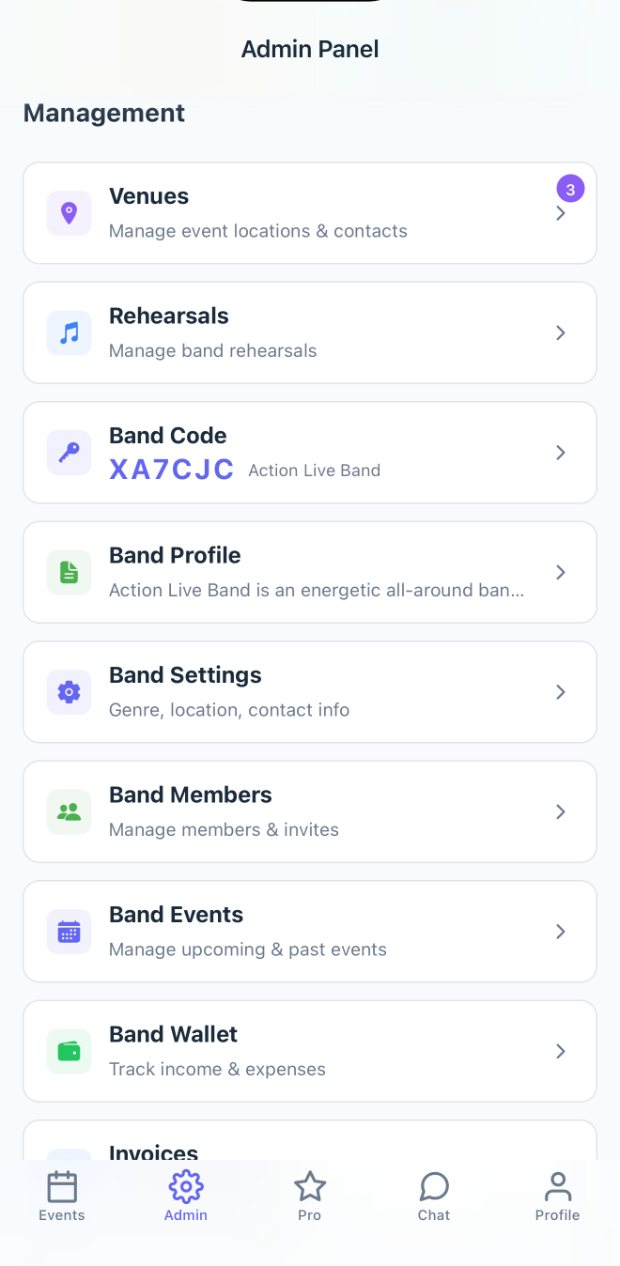
Admin panel: wallet
Income and expenses, per gig
Every event and every rehearsal can carry its own income and expenses. Not one annual total, but this gig: what the venue paid, what the van cost, what the rehearsal room was billed at. Each entry has a title, an amount, a currency and a note, and can be attached to the event it belongs to.
That is the difference between knowing the band turned over some amount last year and knowing which gigs were actually worth playing.
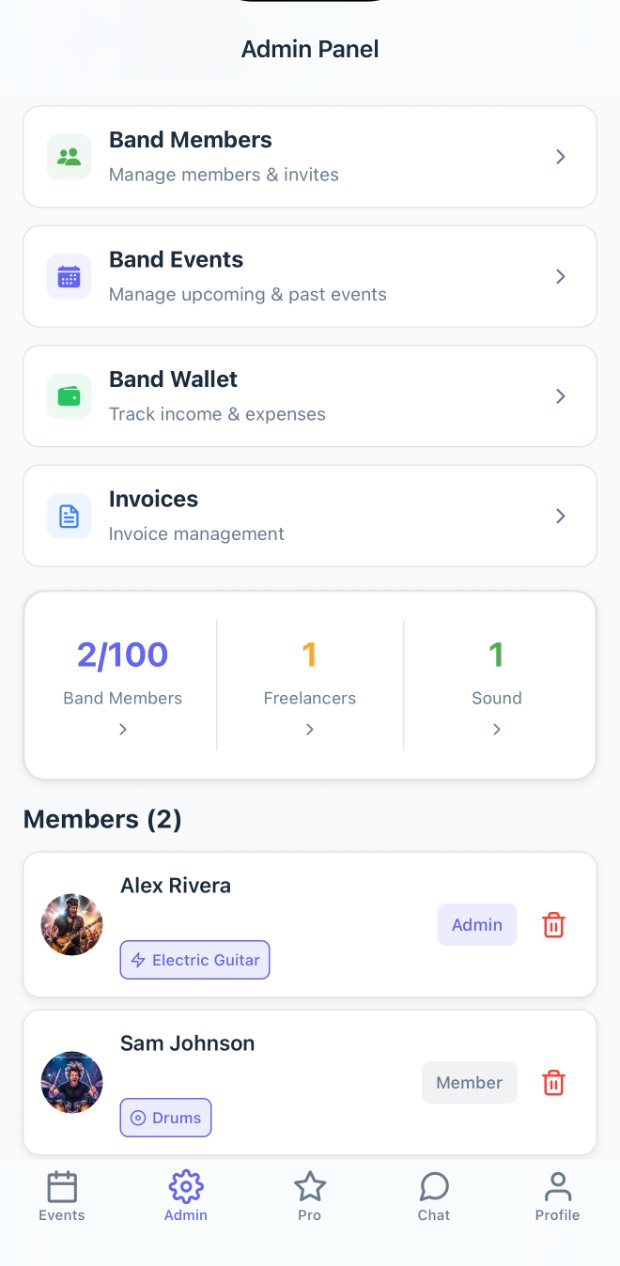
Admin panel: overview
Who gets what
Payments are recorded per person per event. Each one holds the amount owed, the amount actually paid so far, and a status: pending, partly paid, or paid. Partial payment is a real state rather than something you approximate, because in practice a deposit arrives first and the rest follows.
Members see their own earnings and their own history. Admins see the band's. A stand-in who played two gigs sees those two, not the rest of the year.
Invoices with your own logo
Invoices are written in the app and come out as a PDF with the band's own logo at the top. Line items with quantities and prices, a subtotal, VAT at the rate the band has set, and a total. Invoice number, invoice date, due date and payment terms, plus a free note if the client needs one.
The invoice is prefilled with the band's own details, so the address, bank details and tax numbers do not have to be typed out per invoice.
What an invoice holds
•Your band's logo on the document
•Line items, subtotal, VAT and total
•Invoice number, date, due date and payment terms
•Client details, including the client's country
•Downloadable as PDF
Pro
It asks for the fields your country uses
This is the part most tools get wrong. An invoice is not the same document everywhere, and MyGigFlow does not pretend it is. Which fields the invoice asks for follows the band's business country.
A Dutch band fills in a KvK number, a VAT number and an IBAN. An American band fills in an EIN, a sales tax ID, an account number and a routing number. A band somewhere with neither of those systems gets a neutral pair - a company registration number and a tax ID - plus IBAN and BIC where those apply. Nobody is asked for a KvK number they do not have.
Amounts are formatted the way that combination of language and country writes money, which is why a yen amount prints without decimals and a dinar amount with three. The currency itself is a band setting: the band decides what its money is, regardless of what language the person reading it uses.
Seven languages on the document
MyGigFlow carries invoice labels in seven languages: Dutch, English, German, Spanish, Chinese, Portuguese and French. Every heading on the document - invoice number, bill to, description, quantity, subtotal, VAT, total - exists in all seven.
The tax line carries the label the band gives it, so a band that does not call it VAT does not have to.
What the year looked like
Alongside the per-gig figures the app keeps a running picture of the band: how many events, total earnings, total time on stage, the average a gig brings in, this month against this year, which venues you play most, and how reliably each member turns up.
It is the same data seen from further away, which is what you want in front of you when a venue asks what you charge.
Your income per month, as a chart
A list of gigs tells you what happened. A chart tells you what your year is doing. The app draws your income per month, so a quiet March and a heavy September stop being a feeling and become a shape.
There are two of these, and the difference is the point. Every musician has their own, in their profile: what you earned, in the months you earned it, across every band you play in. Band admins also get the band's, which is a different question with a different answer.
The current month is marked, because a half-finished month next to eleven whole ones is easy to misread. Booked but unpaid is shown as its own figure rather than folded into the total, so you can see what is still outstanding without doing arithmetic.
•Your own income per month, across all your bands
•The band's figures as well, for admins
•The current month marked as unfinished
•Booked but not yet paid, kept separate
Frequently asked questions
Can I generate invoices in the app?+
Yes. Band admins write an invoice in the app and download it as a PDF with the band's own logo on it. Line items, VAT, payment terms and due date are all part of the document.
Does the invoice work outside the Netherlands?+
Yes. Which fields the invoice asks for follows the band's business country - a KvK and VAT number and an IBAN for a Dutch band, an EIN and a routing number for an American one, and a neutral company registration and tax ID elsewhere. Amounts are formatted the way that country writes money.
Which currency does the band work in?+
Whichever one it sets. Currency is a band-level setting, so a Dutch-speaking admin of an American band sees dollars and an English-speaking admin of a Dutch band sees euro. The language you read the app in does not change the money.
Can members see what everyone else earns?+
No. Members see their own earnings and their own history. Admins see the band's figures.
Can I record a payment that only came in partly?+
Yes. A payment holds both the amount owed and the amount received so far, with pending, partly paid and paid as separate states, which is what actually happens when a deposit arrives before the rest.
Do rehearsals count towards the figures?+
Rehearsals carry their own income and expenses, so a rehearsal room that gets billed lands in the same place as everything else the band spends.
Can I see what I earned per month?+
Yes. Your profile has a chart of your own income per month, across every band you play in. It marks the current month as unfinished and shows what is booked but not yet paid as a separate figure. Band admins get the same chart for the band.