Almost every band app assumes everyone in it is a band member. That is not how working musicians live. You stand in for one band, run sound for another, and hold a permanent chair in a third. MyGigFlow has separate roles for exactly that, with their own rates and their own way of being asked.
Profile
Three roles, not one
MyGigFlow distinguishes between a band member, a freelancer and a sound engineer at the level of the data, not just the label. The three are asked differently, paid differently, and see different things.
That distinction is the reason the app can do things a single member list cannot. A stand-in does not need to be invited to every rehearsal for the next six months. A sound engineer does not have a share of the fee, they have a rate. Flattening all three into one member list means one of them is always in the wrong place.
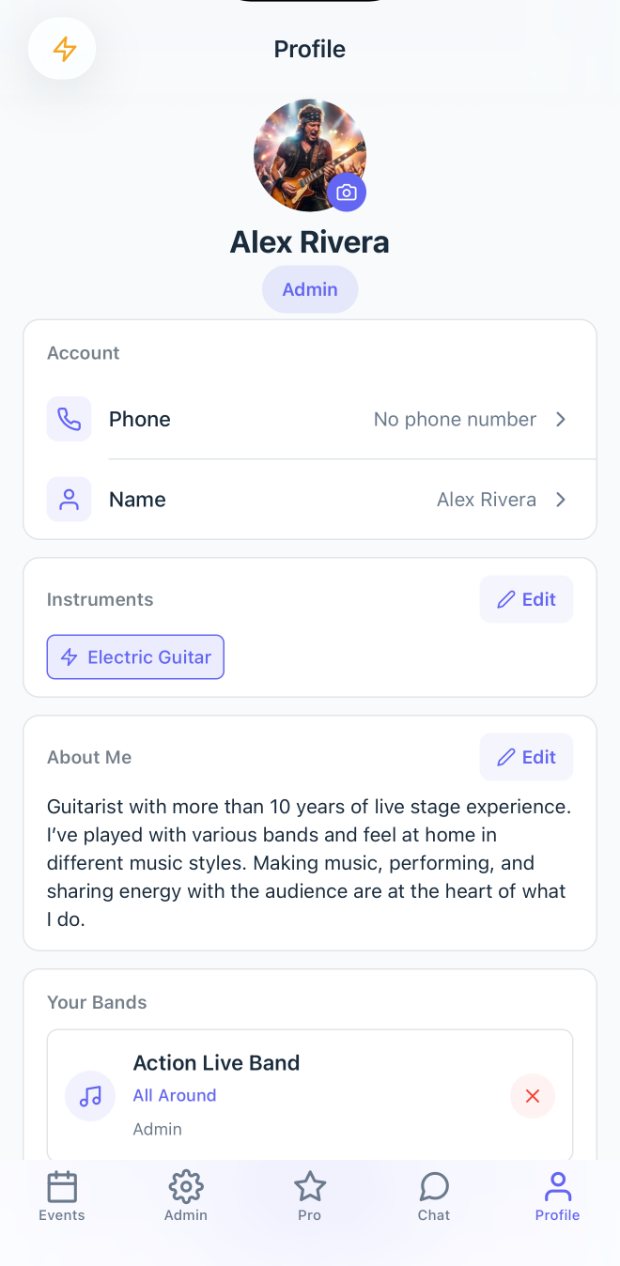
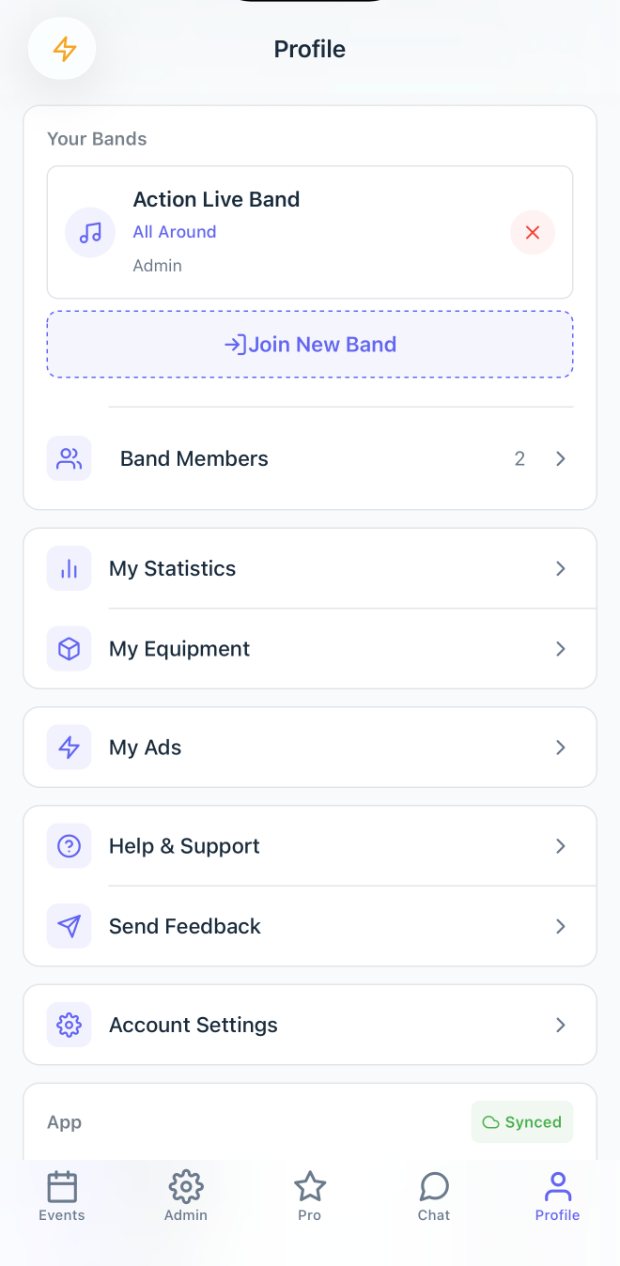
Profile: your bands
How a stand-in gets asked
When a band is short a player for a date, the admin asks for that specific instrument. Several freelancers can be asked at once, and the first to accept takes the slot. The request then closes for everyone else, so nobody is left waiting on an answer that no longer matters.
You see the gig before you say yes: the date, the venue, the timeline for the day, and the rest of the confirmed line-up. Once you accept you have the same access to that event as anyone else on it - the setlist, the documents, the tasks and the event chat - without being pulled into everything else the band does.
As a freelancer
•Asked per gig and per instrument, not signed up to a whole calendar
•First to accept fills the slot; the rest are released
•Full access to the gig you accepted, and nothing more
•Your own earnings per gig, visible to you
Ads
Sound engineers set their own price
This is where MyGigFlow does something no other band app does. A sound engineer in the app is not a member with a note about money. They carry a rate structure.
You choose how you work: an hourly rate, a set fee for the job, or by quote. You set a minimum booking, so a two-hour minimum is a fact of the record rather than something you have to remember to mention. You list your specialties and write a short profile, and bands see that before they ask.
When a band asks you for a gig, you do not simply accept or decline. You can come back with your own proposed rate and a message explaining it. The request then sits at pending approval until the band admin accepts. The whole negotiation is attached to that event, in writing, which means the figure everyone agreed on is still findable in March.
As a sound engineer
•Rate type: hourly, a set fee, or by quote
•A minimum booking in hours
•Specialties and a profile bands read before asking
•Counter with your own rate and a message; the admin approves it
•The agreed figure stays attached to the gig
Joining a band, and the counter-offer
You join a band by entering the code its admin gives you. Your request arrives with your profile, your instruments, your experience and, if you are an engineer, your rate. You can add a short message with it.
The admin does not only have yes and no. If they think you fit better as a stand-in than as a permanent member, or the other way round, they can send back a counter-offer with a different role. That is a real conversation instead of a rejection you have to interpret.
Standing in today, in the band next year
Freelancers who keep coming back tend to become members eventually. In MyGigFlow that is a step, not a re-registration: a band can invite an existing freelancer or engineer to become a full member, and the history comes along.
It also works the other way. Your role lives on the band, not on your account, so being permanent in one band and a stand-in in two others is the normal case rather than a workaround.
What it costs you
Nothing. Playing is free, and that includes freelancers and sound engineers. You see your gigs, confirm attendance, read setlists and documents, chat with the band and track your own earnings without paying anything.
Only the person running a band pays, and they pay per band they run.
Asked, and you see it straight away
The awkward moment used to be between the invitation and the answer. You got asked, you said yes, and only then did the gig actually become visible to you.
Now the gig is there from the moment you are asked. Date, time, venue, who else is on it: you decide with the thing in front of you instead of agreeing to a line in a notification.
The gigs land in your calendar, and only yours
If you stand in for four bands, four group chats is not a diary. The app gives you one personal link that Google Calendar, Apple Calendar and Outlook can subscribe to, and it carries every band you work with.
The important part is what it leaves out. You see the gigs you were asked for and nothing else. A band's other dates, the ones nobody called you about, are not in your feed. That is the same rule the app follows on screen, and it is the reason this link is safe to point at a calendar you share with someone.
No rate and no payment detail goes into it either. What is in your calendar is the where and the when.
•One link for every band you stand in for
•Only the dates you were actually asked for
•No rates in the feed
•Yours to switch off
Frequently asked questions
Do freelancers and sound engineers pay for MyGigFlow?+
No. The app is free for everyone who plays or works a gig. Only band admins pay a subscription, per band they run.
Can I be a stand-in in one band and a member of another?+
Yes. Your role is set per band, not per account. One account holds every band you work with and you switch between them in the app.
How do I set my rate as a sound engineer?+
You pick a rate type - an hourly rate, a set fee for the job, or by quote - and a minimum booking in hours. Bands see that when they consider asking you. When you are asked for a specific gig you can still propose a different rate for that job, with a message.
What happens if two bands ask me for the same night?+
You answer each gig separately, so nothing is booked on your behalf. Because the same account holds all your bands, you can see both requests next to each other before you decide.
Do I see everything the band does once I accept a gig?+
You get access to the gig you accepted: its timeline, tasks, documents, setlist and chat. You are not added to everything else on the band's calendar.
Can a band ask me to become a permanent member later?+
Yes. A band can invite an existing freelancer or sound engineer to become a full band member, and your history with that band comes along.
Do I see the band's other gigs in my calendar?+
No. The calendar feed carries only the dates you were asked for. A band's other gigs, the ones you were not invited to, never appear in it. That is the same rule the app applies on screen.
Do I see the gig before I accept it?+
Yes. From the moment you are invited the gig is visible: date, time, venue and who else is on it. You decide with the details in front of you.