Most bands run on a group chat, a shared spreadsheet and someone's memory. That works until a gig moves, a player drops out two days before the show, or nobody can remember what the sound engineer was quoted. MyGigFlow puts the gigs, the rehearsals, the line-up, the documents and the money in one place, on iOS and Android, in seven languages.
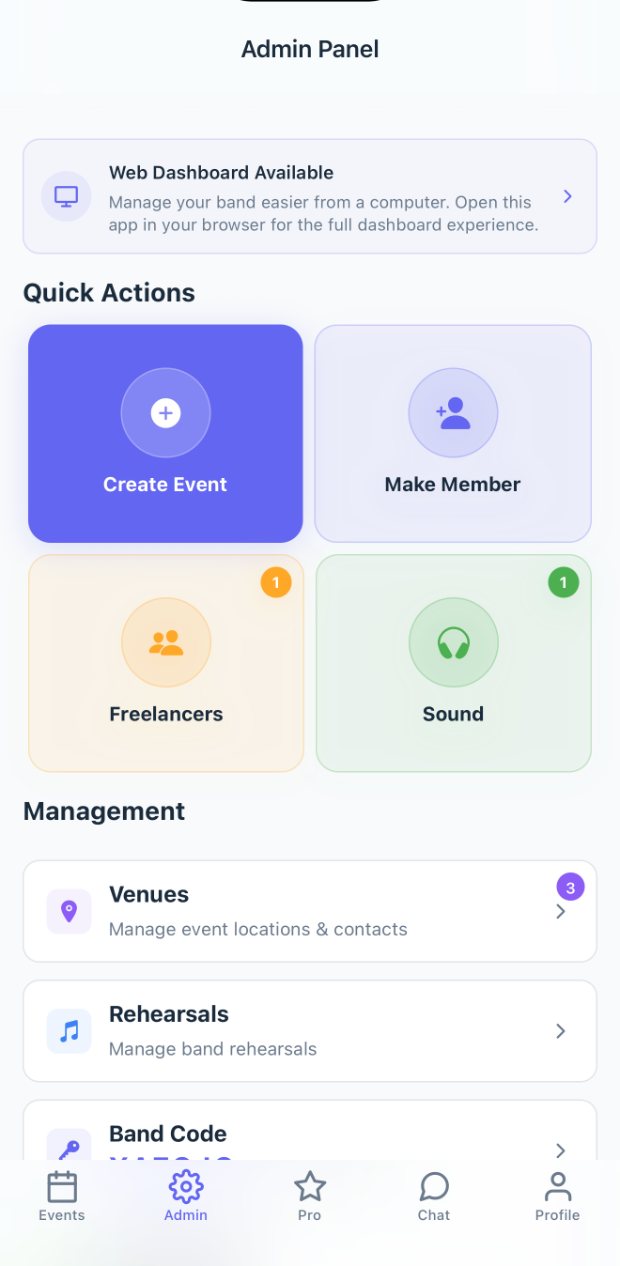
Admin panel
What band management actually involves
Running a band is four jobs at once. There is the calendar: which gigs are booked, which rehearsals are scheduled, who has confirmed. There is the line-up: who plays what, who stands in when a regular cannot, which sound engineer is on the job. There is the paperwork: contracts, riders, stage plots, setlists. And there is the money: what the gig pays, how it is split, and who still has to be invoiced.
Most tools cover one of those four. A shared calendar knows nothing about who confirmed. A group chat holds the rider until it scrolls away. A spreadsheet tracks the fee but not who played. MyGigFlow was built around the idea that these are not four problems but one, because every one of them hangs off the same event.
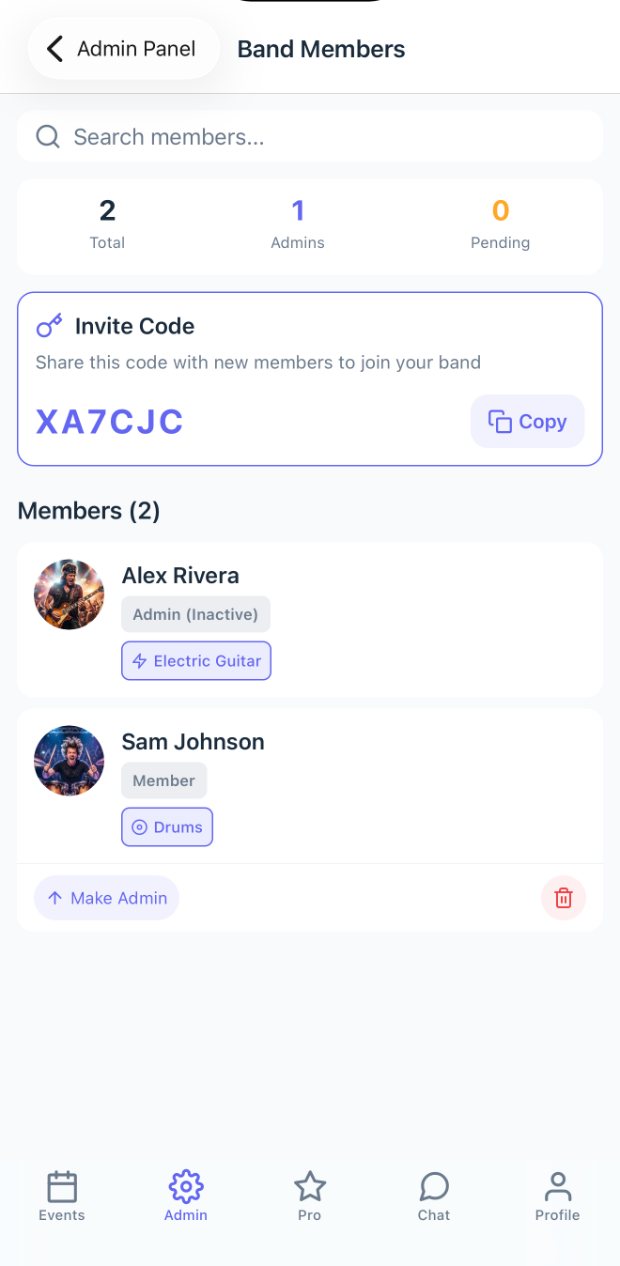
Band members
Four kinds of people, not one
This is where MyGigFlow differs most from the alternatives. Most band apps assume everyone in the app is a band member. In practice a working band is a mix, and the app knows the difference.
A band member is a regular: part of the permanent line-up, invited to everything by default. A freelancer is a stand-in, brought in for a specific gig on a specific instrument. A sound engineer works to a rate rather than a share, and negotiates it. An admin runs the band, creates the events and approves who joins.
Roles in the app
•Band member - the permanent line-up, invited to every event by default
•Freelancer - a stand-in, asked per gig and per instrument
•Sound engineer - works to an hourly rate, a set fee, or by quote
•Admin and owner - create events, manage the roster, handle the money
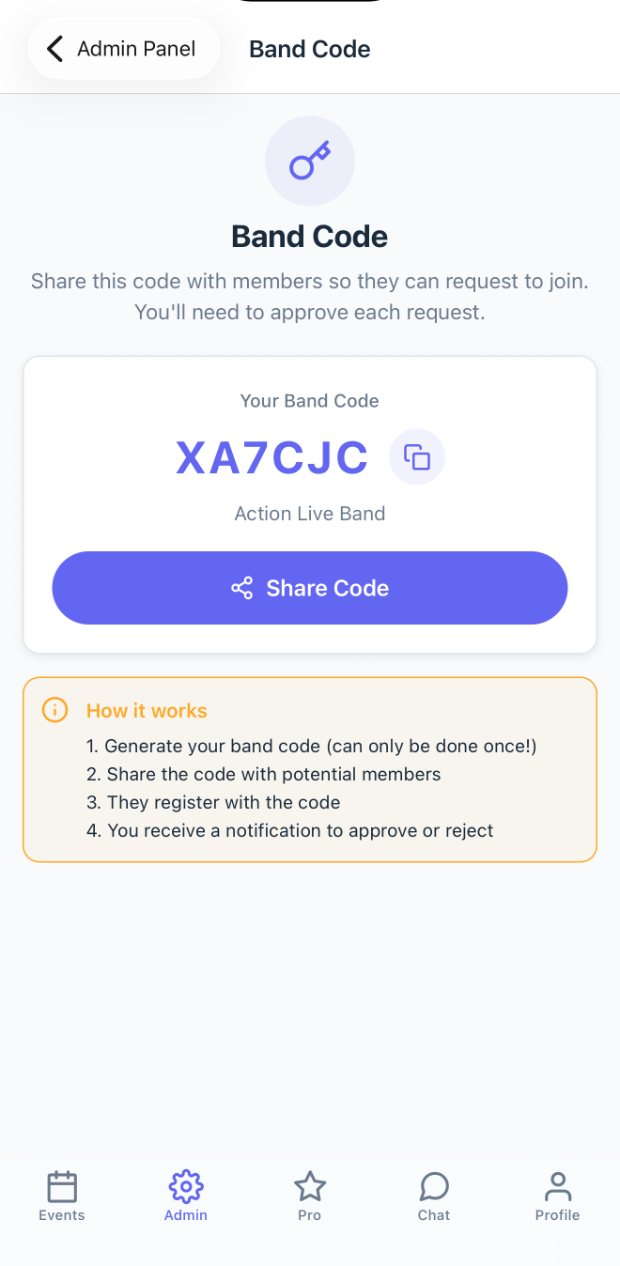
People join by entering the band code the admin shares with them. The request lands with the admin, who sees the profile, the instruments and any rate before deciding. An admin who thinks a candidate fits better as a stand-in than as a regular can send back a counter-offer with a different role instead of simply refusing. A freelancer who keeps turning up can be invited to become a full band member later.
Band code
Gigs, from booking to confirmed line-up
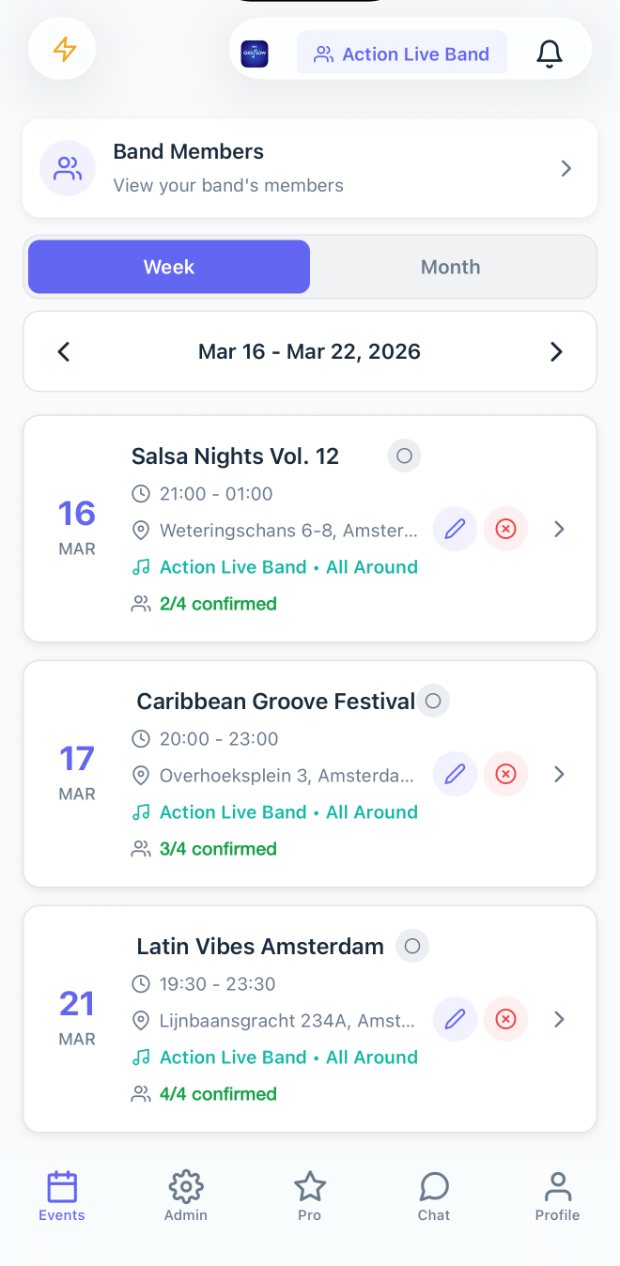
An event holds everything that belongs to it. The date and the venue, the timeline for the day, the tasks that need doing, the documents, the equipment, the setlist, and a chat that only the people on that gig can see.
Everyone invited answers yes, no or maybe, and the admin sees the count at a glance rather than counting thumbs-up in a chat. Attendance is matched on email address, so someone who plays in three of your bands under two phone numbers still resolves to one person.
What an event carries
•Confirmations per person, with a running total for the admin
•A timeline for the day: load-in, soundcheck, doors, on stage
•Tasks assigned to a named person, with notes and a due date
•Contracts, riders and stage plots attached to the gig itself
•Equipment lists per event
•A chat per gig, separate from the band-wide chat
Events
Filling a gap in the line-up
When a regular cannot make a date, the admin asks for a stand-in on that instrument. Several freelancers can be asked at once; the first to accept takes the slot and the request closes for the rest. Nobody has to chase four people in four separate chats and then remember to tell three of them it is covered.
Sound engineers work differently, and the app treats them differently. An engineer carries a rate type - hourly, a set fee for the job, or by quote - along with a minimum booking and a list of specialties. When they are asked for a gig they can come back with their own proposed rate and a message. The request sits at pending approval until the admin accepts it. That negotiation happens inside the app, in writing, attached to the event, instead of in a chat thread nobody can find in March.
Rehearsals get the same treatment
A rehearsal is not a lesser kind of event, and MyGigFlow does not treat it as one. Rehearsals carry their own attendance, their own tasks, their own documents, their own chat and their own costs. If the rehearsal room is billed, that goes in the same place as everything else the band spends.
Alongside that sits an availability calendar. Members mark themselves available, unavailable or unsure per date, with a note if there is something to explain. Picking a rehearsal date becomes a matter of reading the calendar rather than sending a message and waiting a day and a half for the last reply.
Setlists and repertoire
The repertoire is the band's own song library: every song you can play, with the artist, the running time, the key, the tempo, a note, and a link to a recording if you want one. It lives at band level, so it survives individual gigs.
A setlist is built from that library, and the app adds up the running time as you go, so you know whether you have forty-five minutes or an hour before you walk on. One setlist can be attached to several gigs and to rehearsals at the same time, which is what actually happens when you play the same set three weekends running.
What the gig pays
Income and expenses are recorded per event and per rehearsal, so the question is not what the band earned last year but what this gig earned after the van and the rehearsal room. Members see their own earnings; admins see the band's.
Invoices are generated in the app and come out as PDF with the band's own logo on them. The invoice asks for the fields that belong to the band's country - a Dutch band fills in a KvK and VAT number and an IBAN, an American one an EIN and a routing number - and amounts are formatted the way that country writes money.
Everyone in more than one band
Musicians rarely play in exactly one band. One account holds all of them, and you switch between them inside the app. Being a regular in one and a stand-in in another is normal, and the app is built for it: your roles are per band, not per account.
Payment follows the same logic. Playing is free. Only the person running a band pays, and they pay per band they run.
The run sheet, and a rider you do not have to retype
An event carries a run sheet: what happens at what time, from load-in to the last note. Tasks hang off names, and the person who has the task ticks it off themselves, so nobody has to ask whether it happened.
The rider is the other half of that. Most bands already have theirs as a PDF, and until recently the app made you type it out again. Now you upload the file, and the text field stays next to it for the one line the PDF does not cover.
•A run sheet per gig and per rehearsal
•Tasks on a name, ticked off by that person
•Upload the rider as a PDF, PNG or JPEG
•A note next to the file for what it does not say
Your gigs in the calendar you already use
Nobody wants a second calendar. The app gives you a personal link that Google Calendar, Apple Calendar and Outlook can subscribe to, and from then on your gigs and rehearsals sit alongside the school run and the day job.
Two things it deliberately does not do. It does not show you the whole band's diary, only what you were asked for, which is the same rule the app itself follows. And no fee, rate or payment detail ever goes into it, so the calendar you share with a partner or an employer stays free of your money.
The link is yours alone and you can switch it off, which kills every subscription made with it. Bear in mind that a calendar decides for itself how often it checks for changes, and that can take hours. For a change on the day of the gig, the notification in the app gets there first.
•One link, for Google, Apple and Outlook
•Gigs and rehearsals, only the ones you were asked for
•No fees or payment details in the feed
•Switch it off and every subscription stops
Running the band from a computer
Some jobs are miserable on a phone. Building a season of gigs, going through an invoice, reading a long thread: those are keyboard jobs.
If you run a band you can open MyGigFlow in a browser. Signing in happens from the app, not with another password: the browser shows a code, you type it into the app and approve it, and you are in. You can see which browsers are signed in and end any of them, which matters on a computer that is not yours.
This is an admin thing, and it is worth saying plainly. Members, stand-ins and sound engineers use the app on their phone, where everything they need is free. The browser is for whoever is doing the running.
Frequently asked questions
Is MyGigFlow free to use?+
Yes, for everyone who plays. As a band member, freelancer or sound engineer you can see your gigs, confirm attendance, chat, read setlists and documents and track your earnings without paying anything. Only band admins pay a subscription of EUR 3.99 per month or EUR 39.99 per year, per band they run.
How do I join a band?+
The admin shares a band code with you. You enter it in the app and your request goes to the admin, who sees your profile and instruments before approving. Once approved you have access to the band.
Can I play in more than one band?+
Yes. One account holds every band you play in and you switch between them in the app. Your role is set per band, so you can be a permanent member of one and a stand-in in another. If you run several bands, each one needs its own admin subscription.
What is the difference between a member, a freelancer and a sound engineer?+
A band member belongs to the permanent line-up and is invited to everything by default. A freelancer is asked per gig and per instrument, and the first one to accept fills the slot. A sound engineer works to a rate - hourly, a set fee, or by quote - and can propose their own rate when asked, which the admin then approves.
What languages does the app speak?+
Seven: Dutch, English, German, Spanish, Chinese, Portuguese and French. The app follows your device language if it is one of those.
Is my data safe?+
Your data is stored in the cloud and reachable from any device you sign in on. MyGigFlow is GDPR compliant and your data is never sold to third parties. You can request deletion at any time from the app settings.
Can I get my gigs in my own calendar?+
Yes. The app gives you a personal link that Google Calendar, Apple Calendar and Outlook can subscribe to. You see the gigs and rehearsals you were asked for, and no fees or payment details go into the feed. Your calendar decides for itself how often it checks, which can take hours, so last-minute changes still reach you faster through the app. You can switch the link off at any time.
Can I use MyGigFlow on a computer?+
If you run a band, yes. Band admins open the web dashboard in a browser and sign in from the app: the browser shows a code, you approve it in the app, and no extra password is involved. Members, stand-ins and sound engineers use the app on their phone.